Bacopasides: The Memory-Enhancing Saponins of Bacopa Monnieri
Scientific guide to bacopasides from Bacopa monnieri (Brahmi). Covers their triterpenoid saponin structure, cholinergic and serotonergic mechanisms.
PEPure Extracts
Reviewed by: extraction chemist5 min read
On this page
What Are Bacopasides?
Bacopasides (also called bacosides in older literature) are dammarane-type triterpenoid saponins found in Bacopa monnieri, a creeping marsh plant known as “Brahmi” in Ayurvedic medicine. Brahmi has been used as a cognitive enhancer in the Indian subcontinent for over 3,000 years, traditionally given to scholars and students to improve memory and learning capacity. Modern pharmacological research has confirmed that the bacopasides are the primary compounds responsible for these cognitive effects.
The two most important bacopasides are bacopaside I and bacoside A3, along with bacopaside II, bacopaside X, and several related jujubogenin and pseudojujubogenin glycosides. Commercial standardized extracts (such as Synapsa, Bacognize, and KeenMind) are typically standardized to 20–55% total bacosides, providing the concentrations used in clinical research.
Bacopaside Chemical Profile
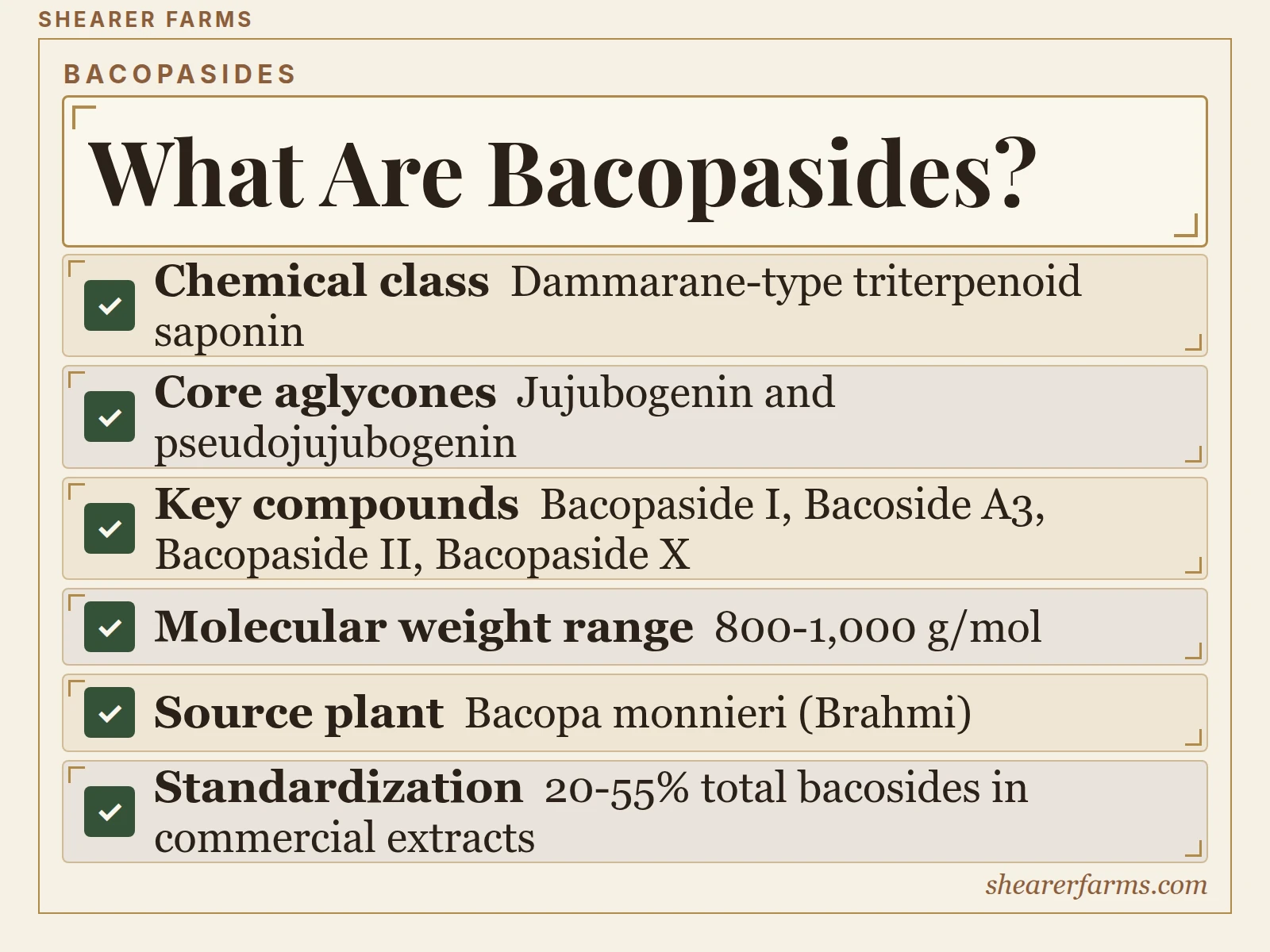
Chemical class: Dammarane-type triterpenoid saponin
Core aglycones: Jujubogenin and pseudojujubogenin
Key compounds: Bacopaside I, Bacoside A3, Bacopaside II, Bacopaside X
Molecular weight range: 800–1,000 g/mol
Source plant:Bacopa monnieri (Brahmi)
Standardization: 20–55% total bacosides in commercial extracts
What Are Bacopasides?, from the What Are Bacopasides? section of this guide.
Mechanisms of Action
Cholinergic Enhancement
Bacopasides enhance cholinergic neurotransmission through multiple complementary mechanisms. They inhibit acetylcholinesterase (AChE), the enzyme that degrades acetylcholine at the synapse, effectively increasing acetylcholine availability. They also upregulate choline acetyltransferase (ChAT), the enzyme that synthesizes acetylcholine, and increase muscarinic acetylcholine receptor density in the hippocampus. This triple action on the cholinergic system, reduced degradation, increased synthesis, and enhanced receptor availability, provides a robust basis for memory improvement.
Serotonergic Modulation
Bacopa extract increases serotonin levels and modulates 5-HT3A receptor activity in the hippocampus. The 5-HT3A receptor is an ion channel receptor involved in learning-related synaptic plasticity. This serotonergic activity may contribute to Bacopa’s anxiolytic effects and its ability to improve learning in high-stress conditions.
Neuroplasticity and Dendritic Growth
Perhaps the most mechanistically significant finding is that bacopasides promote dendritic branching and synaptic proliferation in the hippocampus, the brain region most critical for memory formation and consolidation. In animal models, chronic Bacopa administration increased dendritic intersection numbers and branch points in CA3 hippocampal neurons, a structural correlate of enhanced memory capacity. This process requires sustained exposure, which explains why Bacopa’s cognitive effects develop gradually over 4–12 weeks rather than appearing after a single dose.
Antioxidant Neuroprotection
Bacopasides scavenge reactive oxygen species and upregulate endogenous antioxidant enzymes (SOD, catalase, glutathione peroxidase) in brain tissue. They also reduce lipid peroxidation in the hippocampus and prefrontal cortex, protecting neuronal membranes from oxidative damage. This neuroprotective activity may contribute to Bacopa’s long-term cognitive benefits and its traditional use as a brain longevity tonic.
The Patience Factor Unlike stimulant nootropics that produce immediate effects, Bacopa’s cognitive benefits develop gradually over weeks of consistent use as structural neuroplastic changes accumulate. Most clinical trials demonstrate significant cognitive improvements at 8–12 weeks, with some measurable effects beginning at 4 weeks. This slow-onset, sustained-benefit profile reflects actual neurobiological changes (dendritic growth, synaptogenesis) rather than transient neurochemical shifts, and it means that patience and consistency are essential for experiencing Bacopa’s full potential.
Clinical Evidence
Study
Key Finding
Stough et al. (2001), 46 subjects, 12 weeks
300 mg/day significantly improved speed of visual information processing, learning rate, and memory consolidation vs. placebo
Roodenrys et al. (2002), 76 adults, 12 weeks
Significant improvement in retention of new information (delayed recall) in healthy older adults
Morgan & Stevens (2010), meta-analysis of 6 RCTs
Consistent evidence for improved attention and cognitive processing across trials; strongest effects on memory tasks
Kongkeaw et al. (2014), systematic review, 9 RCTs
Confirmed cognitive enhancement effects, particularly for attention, cognitive processing, and working memory
Peth-Nui et al. (2012), 60 elderly, 12 weeks
Improved attention, cognitive processing, working memory, and reduced depression and anxiety scores
The Plant: Bacopa Monnieri
Bacopa monnieri is a perennial creeping herb found in wetlands throughout South and Southeast Asia, Australia, and parts of the Americas. It produces small white or blue flowers and succulent leaves that contain the highest bacopaside concentrations. The entire aerial portion of the plant is used in Ayurvedic preparations.
The plant has a bitter taste, which traditional preparations often masked with ghee (clarified butter) or honey. Modern standardized extracts eliminate the bitterness while concentrating the active compounds to clinically validated doses.
Safety and Practical Considerations
Gastrointestinal effects: The most common side effect is mild nausea or stomach upset, particularly when taken on an empty stomach. Taking Bacopa with food or fat (which also improves absorption of the lipophilic saponins) minimizes this
Thyroid: Bacopa may increase T4 thyroid hormone levels. Individuals with thyroid conditions should monitor levels and consult their physician
Cholinergic interactions: Because of its cholinergic enhancement, Bacopa should be used cautiously alongside cholinesterase inhibitors (donepezil, galantamine) or cholinergic medications
Fertility: High-dose animal studies suggest reversible effects on sperm production. Clinical significance at human supplementation doses is unclear
Sedation: Some individuals report mild drowsiness, particularly initially. This typically resolves with continued use or by adjusting timing to evening dosing
Dosing: 300–600 mg/day of extract standardized to 20–55% bacosides, taken with food. Minimum 8–12 weeks for cognitive effects to manifest
Reading a Label: Dose Arithmetic
The number on the front of a bacopa bottle is the weight of the extract, not the weight of the active compounds. The compounds are a percentage of that extract, and the percentage is what the label calls standardization. Multiply the two and you have the milligrams of total bacosides in each dose. This is arithmetic on the figures already given above (300–600 mg of extract, standardized to 20–55% bacosides), and it is the quickest way to compare two products that look similar on the shelf.
Formula: extract per dose (mg) × standardization (as a decimal) = total bacosides per dose (mg).
Extract per day
At 20% bacosides
At 40% bacosides
At 55% bacosides
300 mg
60 mg
120 mg
165 mg
450 mg
90 mg
180 mg
247.5 mg
600 mg
120 mg
240 mg
330 mg
The same 300 mg capsule can carry anywhere from 60 mg to 165 mg of bacosides depending on the standardization. That is nearly a threefold spread inside the stated dosing range, so the percentage on the label matters as much as the milligrams. When a label gives only a weight and no percentage, the bacoside content cannot be worked out, and the product cannot be compared with the doses used in the trials.
Worked Example
A bottle lists 150 mg of extract per capsule, standardized to 40% bacosides. One capsule holds 150 × 0.40 = 60 mg of bacosides. To reach 300 mg of extract per day you would take two capsules, which is 120 mg of bacosides. To reach 600 mg of extract per day you would take four capsules, which is 240 mg. A second bottle lists 300 mg per capsule at 20%. One capsule holds 300 × 0.20 = 60 mg of bacosides, the same as one capsule of the first bottle, but it takes twice the extract to get there. If the two bottles cost the same per capsule, the second is the more expensive way to buy the same bacosides.
Cost Per 100 mg of Bacosides
To compare price fairly, divide the bottle price by the total milligrams of bacosides in the whole bottle, then multiply by 100. The table uses a made-up price of $20 per bottle of 60 capsules purely to show the method. Replace it with the real figures from your label.
Capsule
Bacosides per capsule
Bacosides per bottle of 60
Cost per 100 mg at $20 a bottle
150 mg at 40%
60 mg
3,600 mg
$0.56
300 mg at 20%
60 mg
3,600 mg
$0.56
300 mg at 55%
165 mg
9,900 mg
$0.20
Equal price, very different content. The method works for any product, and it is the same one used when reading a certificate of analysis for any extract.
What the Clinical Table Adds Up To
The clinical evidence table above lists three single trials and two reviews. Counting only the three single trials, the enrolled subjects are 46 + 76 + 60 = 182 people, and every one of those trials ran for 12 weeks. The two reviews pool earlier trials: the Morgan and Stevens meta-analysis covered 6 randomized controlled trials and the Kongkeaw systematic review covered 9. The reviews overlap in the trials they draw on, so their counts cannot be added together to claim 15 separate trials.
Source type
Entries in the table
What the count means
Single trials (Stough, Roodenrys, Peth-Nui)
3
182 subjects in total, all 12 weeks
Meta-analysis (Morgan and Stevens)
1
Pools 6 randomized controlled trials
Systematic review (Kongkeaw)
1
Pools 9 randomized controlled trials; may overlap with the above
Two points follow from the table itself. First, the trial length of 12 weeks matches the guidance in this guide that effects build over 8–12 weeks, so a product tried for two weeks has not been tested the way the studies tested it. Second, the three single trials used populations that differ (healthy adults, healthy older adults, elderly volunteers), so a result in one group is not automatically a result in another.
A 12-Week Plan
Because the guide places the first measurable effects around 4 weeks and the clearest ones at 8–12 weeks, the practical question is how to run a fair trial on yourself. The plan below uses only the timings and dosing already stated in this guide. It is a template, not a medical recommendation, and anyone on the medications listed under Safety should talk to a physician first.
Weeks
What you do
What to check
Before week 1
Read the label and work out total bacosides per dose with the formula above. Choose a time of day and a meal to take it with.
Write down the product, the extract weight, the standardization percentage and the start date.
1–2
Take the dose with food or fat. Keep the dose the same each day.
Stomach upset, drowsiness. If either is a problem, change the timing, for example evening dosing.
3–4
Keep going. Do not raise the dose to speed things up.
Early changes in attention may start to show. Note them without expecting much.
5–8
Keep going at the same dose.
Compare your notes with the first two weeks.
9–12
Keep going. The clinical trials in the table ran for this long.
Decide with your full 12 weeks of notes whether anything changed.
Tracking Sheet
A simple log makes the decision at week 12 honest. Without one, memory tends to smooth over the first few weeks. Copy the table below onto paper or a spreadsheet and fill one row per week.
Week
Dose taken (mg extract)
Taken with food? (yes or no)
Days missed
Side effects
Notes on focus and recall
1
4
8
12
A single missed day matters little, but a week with several missed days breaks the consistency the slow-onset mechanism depends on. If weeks 1–12 contain more than a handful of missed days in total, treat the trial as unfinished and not as a negative result.
Quick Reference Summary
Topic
What this guide says
Compound class
Dammarane-type triterpenoid saponins from Bacopa monnieri
Key compounds
Bacopaside I, bacoside A3, bacopaside II, bacopaside X
Some effects from 4 weeks, most trials show clear effects at 8–12 weeks
Common side effects
Mild nausea or stomach upset, mild drowsiness
Check with a physician first if
Thyroid condition, cholinesterase inhibitor or other cholinergic medication
References
Stough, C. et al. “The chronic effects of an extract of Bacopa monniera on cognitive function in healthy human subjects.” Psychopharmacology, 2001.
Roodenrys, S. et al. “Chronic effects of Brahmi on human memory.” Neuropsychopharmacology, 2002.
Kongkeaw, C. et al. “Meta-analysis of randomized controlled trials on cognitive effects of Bacopa monnieri extract.” Journal of Ethnopharmacology, 2014.
Aguiar, S. & Borowski, T. “Neuropharmacological review of the nootropic herb Bacopa monnieri.” Rejuvenation Research, 2013.
Vollala, V.R. et al. “Enhancement of basolateral amygdaloid neuronal dendritic arborization following Bacopa monniera extract treatment.” Clinics, 2011.
Common questions
What Are Bacopasides?
Bacopasides (also called bacosides in older literature) are dammarane-type triterpenoid saponins found in Bacopa monnieri, a creeping marsh plant known as “Brahmi” in Ayurvedic medicine. Brahmi has been used as a cognitive enhancer in the Indian subcontinent for over 3,000 years, traditionally given to scholars and students to improve memory and learning capacity. Modern pharmacological research has confirmed that the bacopasides are the primary compounds responsible for these cognitive effects.
What is mechanisms of action?
Bacopasides enhance cholinergic neurotransmission through multiple complementary mechanisms. They inhibit acetylcholinesterase (AChE), the enzyme that degrades acetylcholine at the synapse, effectively increasing acetylcholine availability. They also upregulate choline acetyltransferase (ChAT), the enzyme that synthesizes acetylcholine, and increase muscarinic acetylcholine receptor density in the hippocampus. This triple action on the cholinergic system, reduced degradation, increased synthesis, and enhanced receptor availability, provides a robust basis for memory improvement.
What is clinical evidence?
(2001), 46 subjects, 12 weeks: 300 mg/day significantly improved speed of visual information processing, learning rate, and memory consolidation vs. (2002), 76 adults, 12 weeks: Significant improvement in retention of new information (delayed recall) in healthy older adults. Morgan & Stevens (2010), meta-analysis of 6 RCTs: Consistent evidence for improved attention and cognitive processing across trials; strongest effects on memory tasks. (2014), systematic review, 9 RCTs: Confirmed cognitive enhancement effects, particularly for attention, cognitive processing, and working memory.
What is the plant: bacopa monnieri?
Bacopa monnieri is a perennial creeping herb found in wetlands throughout South and Southeast Asia, Australia, and parts of the Americas. It produces small white or blue flowers and succulent leaves that contain the highest bacopaside concentrations. The entire aerial portion of the plant is used in Ayurvedic preparations. The plant has a bitter taste, which traditional preparations often masked with ghee (clarified butter) or honey. Modern standardized extracts eliminate the bitterness while concentrating the active compounds to clinically validated doses.
Are bacopasides safe?
Gastrointestinal effects: The most common side effect is mild nausea or stomach upset, particularly when taken on an empty stomach. Taking Bacopa with food or fat (which also improves absorption of the lipophilic saponins) minimizes this. Thyroid: Bacopa may increase T4 thyroid hormone levels. Individuals with thyroid conditions should monitor levels and consult their physician. Cholinergic interactions: Because of its cholinergic enhancement, Bacopa should be used cautiously alongside cholinesterase inhibitors (donepezil, galantamine) or cholinergic medications.